
When Justice Is Won… But Power Is Still Contested

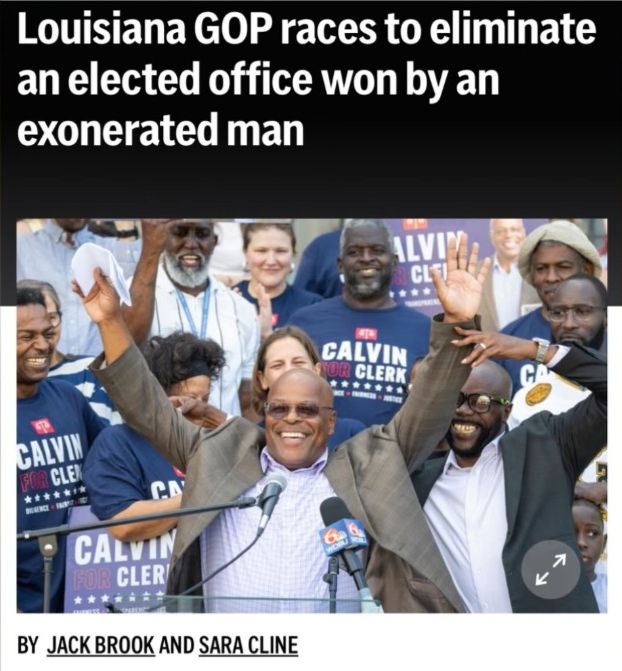
In November, the people of New Orleans made a clear and powerful choice.
Calvin Duncan, a man who spent nearly 30 years imprisoned for a crime he did not commit; was elected with 68% of the vote to serve as Orleans Parish Clerk of Criminal Court. His campaign was rooted in something deeply personal: reforming the very system that once failed him.
Duncan knows firsthand what it means to fight for access to justice. While incarcerated, he struggled to obtain court records, something that should be a basic right. After his release, he continued that fight, eventually becoming a driving force behind the landmark 2020 U.S. Supreme Court decision that ended non-unanimous jury convictions.
His election was not just a win. It was a statement.
A community choosing lived experience.
A community choosing reform.
A community choosing to trust someone who survived injustice to help fix it.
But now, before he can even be sworn in on May 4, Louisiana leadership is moving to eliminate the very position he was elected to hold.
State officials argue that the decision is about “government efficiency” and restructuring the court system. The proposal would merge the criminal and civil clerk offices, a move projected to save approximately $27,300, while the true cost of consolidation remains unknown.
Yet the timing raises serious questions.
Other officials in similar positions would be allowed to serve out their terms. Not Calvin Duncan.
The legislation is being fast-tracked specifically to take effect before his term begins.
To many, this does not feel like reform. It feels like resistance.
Duncan himself has stated that he believes this is retaliation... pointing to years of opposition from state officials, even after his conviction was vacated in 2021 and his name recognized on the National Registry of Exonerations.
And this is where the moment becomes bigger than one man.
Because what we are witnessing is not just a policy decision, it is a test of whether the system is willing to accept change when that change comes from those it once harmed.
At the JAI Foundation, this moment resonates deeply.
We advocate for over 900 individuals still incarcerated under unconstitutional non-unanimous jury verdicts in Louisiana. People who, like Duncan, were denied a full and fair trial. People still waiting for the opportunity to have their cases heard justly.
We are not asking for shortcuts. We are asking for fairness.
And when someone who has endured that injustice rises into a position of leadership, when the people themselves choose that person, it should not be undone.
As Senator Royce Duplessis stated:
“The citizens of New Orleans overwhelmingly said: ‘I want to give this person a chance.’ What this bill does… it disenfranchises everybody.”
This moment forces us to reflect:
Do we truly believe in second chances; or only in theory?
Do we value lived experience in leadership; or only when it remains outside of power?
And when communities speak clearly… are we listening?
Justice reform is not only about correcting the past. It is about shaping the future.
And that future must include the voices of those who have lived through the very systems we are trying to change.
Because real justice does not fear transformation.
It welcomes it.


Comments